

About this guide
Someone who enjoys teaching may feel at home in employee training. Someone who likes untangling numbers may prefer compensation. Compare ten HR roles by the problems you would spend your week solving.
In this guide
A new hire turns up for a first shift and discovers that their name is missing from the training roster. One HR colleague checks the start date. Another arranges the safety orientation. Later, someone looks at why the mismatch happened across two systems. All three helped the same person, using different skills. That is a useful way to enter an HR search: pick the kind of problem you would like to solve.
The 10 roles with the most Jobbol openings
Human resources specialists accounted for 1,644 of the 2,691 U.S. listings in Jobbol’s Human Resources category on November 20, 2026. The specialist label is broad enough to cover very different jobs. Open a title below, add your city and read the first three duties to see what the employer actually needs.
Browse human resources openings by location
| Rank | Occupation | Jobbol openings | What to look for |
|---|---|---|---|
1 | 1,644 | Look for the share of time spent recruiting, onboarding, maintaining records and answering employee questions. | |
2 | 425 | Ask about the employee population, direct reports, local sites and decisions you can make independently. | |
3 | 117 | Check the actual function and reporting line. This broad category label can include enterprise leadership. | |
4 | 111 | Ask who the learners are, whether you design the materials and how the team checks what people learned. | |
5 | 110 | Look for scheduling, onboarding documents and record updates. Ask who handles sensitive escalations. | |
6 | 95 | Check which pay programs or benefit plans you would own, the budget and the size of the team. | |
7 | 86 | Read for salary benchmarking, job descriptions or benefits operations. Ask which data tools you would use. | |
8 | 57 | Distinguish managing trainers and program budgets from personally teaching classes across sites. | |
9 | 12 | Look for the workforce served, experience with agreements and the role you would play in grievances. | |
10 | 4 | Verify that the project concerns people operations. Ask about system rollouts, hiring projects or workforce changes. |
Choose a first search that fits your experience
If you coordinate schedules, chase missing information and keep records accurate, start with HR assistant openings. A person who has organized interviews or helped a new colleague through a first week can also explore specialist roles. In a small organization, a specialist might support an employee from application to departure. In a larger organization, the entire week might be devoted to recruiting for one location. The verbs in the description will tell you more than the title alone.
If teaching energizes you, look for the audience and the assignment. Delivering an existing orientation to twenty people calls for a different portfolio than designing a course for supervisors across five locations. Compensation and benefits roles offer another path for someone who likes checking data, documenting assumptions and explaining the result to a colleague. Manager and executive openings usually describe responsibility for a program, budget or team. Look for work you are ready to own.
What helping a new colleague can show in an interview
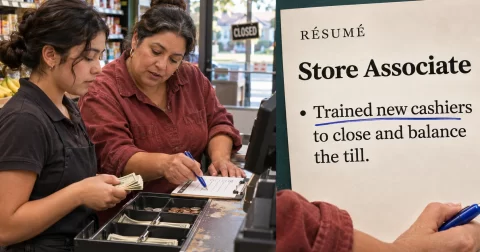
Consider a shift lead who noticed new workers repeatedly missing the same handoff. A strong example describes the missed step, how the lead asked a new worker to demonstrate the process, what changed in the checklist and how the next group used it. A candidate who built a checklist can bring a clean sample made with fictional details. Someone who only used the checklist can describe a problem they spotted and who they involved. Both give you something worth talking about. If you have coached someone through a tricky first shift, practice telling that story in your own words.
HR teams handle sensitive information. For an interview story, describe the process, your action and the outcome using anonymous or fictional details. For a sample spreadsheet, create fresh demonstration data. You can show careful work without bringing an employee file to an interview.
Ask about the workday before you accept
- For recruiting, ask how many roles are open at once and who sets the schedule when an interview falls outside normal hours.
- For employee support, ask what you handle on your own and where an urgent or confidential issue goes.
- For training, ask whether preparation, travel between locations and follow-up are included in the planned workload.
- For benefits or pay work, ask which months are busiest and who checks changes before they reach employees.
What national demand means for your local search
The U.S. Bureau of Labor Statistics projects employment of HR specialists to rise 6% from 2025 to 2035, with about 73,700 openings per year nationwide on average. Replacements account for many of those opportunities. To put the trend to work, run two local searches from the table: one for specialists and one for your preferred specialty. Compare the workforce each employer serves, one skill you already use and one you would need to learn. That gives you a reason to apply that is more specific than “I like working with people.”
Sources
- U.S. Bureau of Labor Statistics - Human Resources Specialists
- U.S. Bureau of Labor Statistics - Training and Development Specialists
Sources reviewed 2026-11-20. Editorial policy