

About this guide
A local median can help you ask a better pay question. Use the historical Dallas example to see how the comparison changes with the job duties, the year of the estimate and the hours you would work.
In this guide
What the Dallas wage figure actually measures
For medical assistants in Dallas-Fort Worth-Arlington, Texas, the May 2023 BLS OEWS table reported a median hourly wage of $18.87 and a mean of $19.50. The estimates refer to that metro and occupation at that time. Higher wages in part of the distribution can pull the mean above the median. Neither number is a starting rate or a wage floor.
Compare a hypothetical offer
Suppose a clinic offers $20 per hour. That is $1.13 above the historical median and 50 cents above the historical mean. For a decision today, look up the latest release for that occupation and area. The employer may require evening hours, experience, bilingual service or different responsibilities. A nearby suburb can also have a very different commute.
Choose the closest occupation before comparing pay
Search job titles can be misleading. An employer may call a position “clinical support associate” even when the duties align with medical assisting, or use a similar title for predominantly reception work. Read the occupational description and compare the tasks. If the job mainly involves billing and scheduling, record that mismatch before treating the medical assistant wage row as your benchmark.
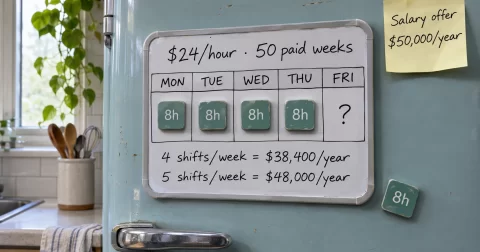
Also check the pay period. A posted daily rate, a salary and an hourly rate can look comparable after conversion while still reflecting different guaranteed hours. If an offer promises an hourly rate but leaves the weekly hours open, calculate a low and high annual amount. Keep that hours question separate from whether the hourly rate is competitive.
Use the historical example to build a current question
Imagine an offer with a $20 base and a $2 evening differential. If only ten hours in a forty-hour week qualify, the illustrative weekly premium is $20, not $80. Compare base with base first, then ask how often those premium hours occur. The official wage estimate is not a description of that employer's particular pay policy.
In your notes, record the source URL, occupation code, release period, metro name and whether the figure is a mean or median. A month later, those five details let you reproduce the comparison. Take one evidence-based question to the employer, such as what experience moves someone within the posted range, instead of presenting an old estimate as a rate the employer must pay.
Ask for the range and its basis
“Could you share the range for this role and where the offered rate sits within it? Which duties, credentials or shift requirements affect placement?” Before negotiating, look for a newer release using the same geography and occupation. Use the latest BLS tables in Sources for a current conversation. If the hourly number works but weekly hours are uncertain, calculate what the offer pays on two different schedules.
Sources
- BLS May 2023 OEWS · Dallas-Fort Worth-Arlington, row 31-9092
- U.S. Bureau of Labor Statistics - Occupational Employment and Wage Statistics, latest area tables
Sources reviewed 2026-11-20. Editorial policy